
FOR GENERAL PRACTICE
What happens between appointments?
Loneliness, money worries and stress do not stop when the appointment ends. They can make a patient's condition worse and bring them back more often.
Joy identifies patients with rising contact through EMIS or SystmOne, matches them with suitable local support and asks for your permission to help.
With the patient’s consent, Joy then automatically contacts them on WhatsApp, explains their options, handles the emails and admin, and keeps encouraging them until they access support. A summary is then prepared for the medical record.
High-intensity patients become middle-intensity patients.
17.5 contacts a year down to 10.5. They still see you, less often, and about medicine.

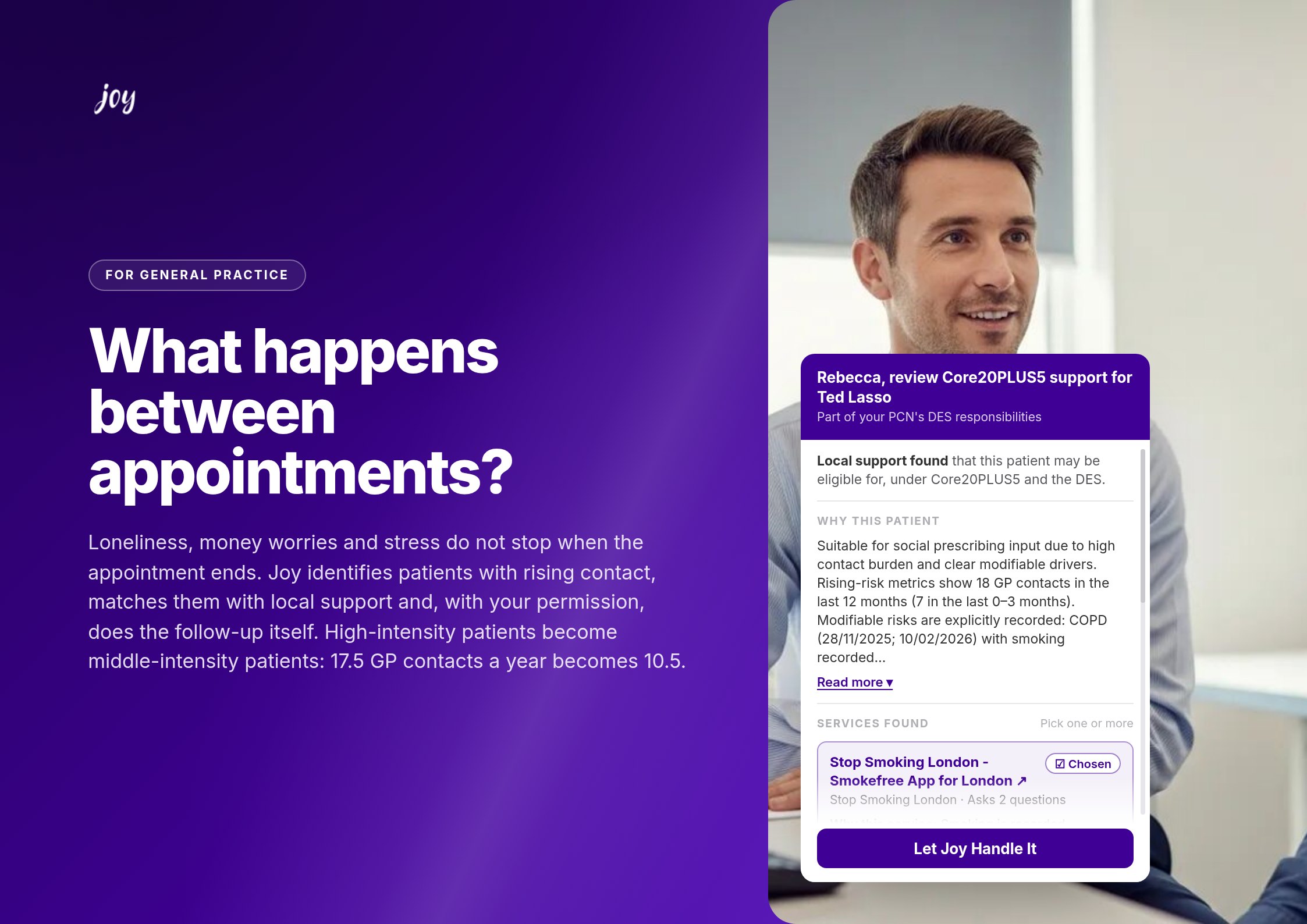
Rebecca, review Core20PLUS5 support for Ted Lasso
Part of your PCN's DES responsibilities
Local support found that this patient may be eligible for, under Core20PLUS5 and the DES.
Why this patient
Suitable for social prescribing input due to high contact burden and clear modifiable drivers. Rising-risk metrics show 18 GP contacts in the last 12 months (7 in the last 0–3 months). Modifiable risks are explicitly recorded: COPD (28/11/2025; 10/02/2026) with smoking recorded…
Read moreServices found
Pick one or more
Stop Smoking London - Smokefree App for London
ChosenStop Smoking London · Asks 2 questions
Why this service: Smoking is recorded alongside COPD (10/02/2026; COPD also recorded 28/11/2025). This is a low-friction, London-wide option with on-demand support, which can reduce COPD flare-ups a…
Read moreStop Smoking
ChooseQuit Right Tower Hamlets · Asks 2 questions
Why this service: Smoking is recorded (10/02/2026) with COPD. This is a local Tower Hamlets service with free quit aids, increasing the chance of a successful quit attempt and reducing COPD-related contacts.


of patients make up 24% of consultations.
Source: Cook, Ali and Dykins, Identifying high-frequency attendees in general practice, British Journal of General Practice, 2017.
Let Joy handle the non-medical problems driving demand
A small group of patients accounts for a large share of consultations.
You already know these patients. They often have a long-term condition, made harder to manage by loneliness, debt, housing, work, caring responsibilities or stress.
A ten-minute appointment cannot resolve those problems. Without the right support, patients get worse and return sooner.
Joy helps by identifying these patients early and connecting them with suitable local services, such as walking groups, money advice, carers’ support and stop-smoking programmes. These services are free to the patient and cost the practice nothing.
Joy does not replace clinical care. It helps address the circumstances making that care harder.
See Joy in three minutes
Who Joy supports, what the clinician sees and what happens after you approve a referral.
Measured using the GP record
For high-intensity patients supported through Joy, average GP contact fell from 17.5 to 10.5 appointments per year, comparing the same patients for 12 months before and after support.
One patient, one year of GP contacts
fewer GP contacts
17.5 to 10.5 contacts per patient per year
Depending on your current setup, between 0% and 2% of your patient list may be referred to local services. Joy typically adds another one or two percentage points.
That is a small proportion of the list, but it can make a significant difference for the patients involved and the clinicians supporting them.
In addition to your care, not instead of it You continue to see the patient when they need medical care. Joy helps with the loneliness, money worries, stress and other non-medical factors that may be bringing them back more often.
Joy also recorded:
fewer A&E attendances
fewer fit notes
Source: Joy platform database, high-dependency patients, GP record before and after. All-time data across nearly 2 million referrals, signposts and support cases since 2019.
Live in more than 2,000 GP surgeries
Joy is commissioned in 28 of England’s 36 integrated care systems and is fully integrated with EMIS and SystmOne.
There is no new clinical system to learn.
GP surgeries live
of England’s 36 integrated care systems
with EMIS and SystmOne
referrals, signposts and support cases every working day
of clinician time per week
Not another to-do list
Most risk-stratification tools identify patients and leave your team to do the rest.
Joy finishes the job.
It identifies the patient, finds suitable services and asks one clear question:
May I help this patient?
If you agree, Joy contacts the patient, works through any barriers and follows up until they engage with support. It then writes a structured summary back into the clinical record.
One click, and it is off your desk.
How Joy works
1. Joy identifies rising risk
Joy runs quietly in the background and identifies patients whose contact with the practice is increasing, before they reach a crisis.
It reviews the last two years of the patient record, giving greater weight to recent activity. It considers:
- GP contact
- Referrals
- Missed appointments
- Coded conditions
- Frailty markers
- Core20PLUS5 priorities
- Deprivation in the patient’s postcode area
This stage follows fixed rules, so the same record produces the same result and the supporting evidence is visible.
2. Joy looks for something a local service can change
Joy considers whether a non-medical factor may be contributing to the patient’s health or contact with the practice.
This could include:
- Smoking
- Alcohol
- Weight or inactivity
- Sleep or diet
- Loneliness
- Housing or debt
- Work
- Caring responsibilities
- Literacy or digital confidence
If the need is purely medical, involves safeguarding, or is already being addressed, Joy stays quiet.
3. Joy finds suitable local services
Joy searches more than 100,000 local services, as well as council, NHS and charity directories.
Potential services are assessed for:
- Relevance to the patient’s needs
- Likelihood that the patient will attend
- Likely impact on the underlying issue
- The GP contact the support may help prevent
If there is no suitable local service with capacity, Joy does not show the prompt.
4. You decide
Joy presents the evidence and suggested services inside EMIS or SystmOne.
You can review the reason, choose one or more services and click Let Joy Handle It.
Doing this in the consultation works best: the patient hears from Joy the same day, while the conversation is fresh, and more of them take the support up.
Joy then:
- Contacts the patient on WhatsApp if you tick to confirm they agree
- Otherwise texts them to ask, if they have agreed to SMS from the practice
- Finds out what matters to them
- Helps with barriers such as transport, cost or confidence
- Supports them until they engage with the service
- Adds a structured summary to the GP record
Consent comes first. Either you confirm the patient is happy to use WhatsApp, or Joy texts them to ask. Patients without SMS consent at the practice are not contacted. WhatsApp only ever sees the patient’s first name, postcode area, practice name and links to services, never medical information.
Nothing happens until a clinician approves it.
What the clinician sees
The JoyConnect card answers three practical questions:
Rebecca, review Core20PLUS5 support for Ted Lasso
Part of your PCN's DES responsibilities
Local support found that this patient may be eligible for, under Core20PLUS5 and the DES.
Why this patient
Suitable for social prescribing input due to high contact burden and clear modifiable drivers. Rising-risk metrics show 18 GP contacts in the last 12 months (7 in the last 0–3 months). Modifiable risks are explicitly recorded: COPD (28/11/2025; 10/02/2026) with smoking recorded…
Read moreServices found
Pick one or more
Stop Smoking London - Smokefree App for London
ChosenStop Smoking London · Asks 2 questions
Why this service: Smoking is recorded alongside COPD (10/02/2026; COPD also recorded 28/11/2025). This is a low-friction, London-wide option with on-demand support, which can reduce COPD flare-ups a…
Read moreStop Smoking
ChooseQuit Right Tower Hamlets · Asks 2 questions
Why this service: Smoking is recorded (10/02/2026) with COPD. This is a local Tower Hamlets service with free quit aids, increasing the chance of a successful quit attempt and reducing COPD-related contacts.
Tower Hamlets Connect - Tower Hamlets Connect
ChooseTower Hamlets Connect · Asks 2 questions
Why this service: A single front door to council and community support in the borough, for anything beyond the quit attempt that is adding to the contact burden.
What a clinician sees in JoyConnect. Synthetic record, real local services.
Why this patient?
It shows how contact is changing and highlights the factors a local service may be able to address.
For example:
This patient has had 18 GP contacts in the last 12 months, including seven in the last three months. Smoking is recorded alongside COPD.
Which services could help?
Joy presents the best-matched services in order of fit and explains why each one is relevant.
You can choose one or more options.
What happens next?
Click Let Joy Handle It.
Joy contacts the patient, helps them access the service and writes the outcome back into the record.
If the timing is not right, leave it. The patient can remain on an active list for an ARRS team member to review later.
You remain in control
Joy suggests. You decide.
Think of it as prescribing support for something other than medicine. There are three options.
Send it
Approve the recommendation and Joy takes over the follow-up.
Leave it
If it is not the right time, nothing happens. The patient can be reviewed later by a member of your personalised care team.
Refer anyone, there and then
Joy is not limited to the patients it identifies. If someone in front of you would benefit, refer them from EMIS or SystmOne in the same consultation, with the same service directory and follow-up behind it.
"My week isn't complete unless I've Joyed a patient. It's nice to know patients are able to get support without it needing too much of my time."
Non-medical by design
Joy does not diagnose, prescribe or change a treatment plan.
Suggesting a walking group, money advice or a carers’ group is the same order of intervention as telling a patient to drink more water, eat better or go for a walk. The difference is that Joy follows up to make sure it happens.
A patient with diabetes who is also struggling with debt still receives their diabetes care. Joy helps address the debt.
The patient may decline the offer, but if they accept, they can begin receiving support for an issue that may be making their health worse.
Joy works alongside clinical care, never instead of it.

Built for neighbourhood working
Integrated neighbourhood working asks general practice to work more closely with community and voluntary services. Joy provides a practical route for making that happen.
Referrals can be made from inside EMIS or SystmOne by a GP, pharmacist, care coordinator, social prescriber or another authorised team member.
Every patient receives the same follow-up, and the outcome is returned to the clinical record.
The whole system can refer in.
This is what good looks like in a mature neighbourhood health service, the sort of thing you can build to.
Every referrer goes straight into support (thin dashed lanes, illustrative routing). GP surgeries also route people through the link workers and neighbourhood teams in the middle, who fan out across the need categories; self-referrals and informal carers sit underneath them. Pill percentages are the modelled target shares.
Source: Joy's view of what good looks like in a mature neighbourhood health service, anchored to the Neighbourhood Health Framework (March 2026), the 10 Year Health Plan and national need indicators, and checked against the neighbourhoods on Joy furthest ahead.

Whatever your link worker capacity
Joy extends the reach of personalised care, whoever is delivering it.
If you already have link workers
Joy makes more of their hours. It finds the patients, prepares the local services and handles the chasing, so your link workers spend their time on the conversations that need a person.
If link worker capacity is limited
Joy gives you reach you would not otherwise have. It contacts the patient, works through barriers and follows up until they are through the door.
Your clinical team still sees them whenever the need is medical.
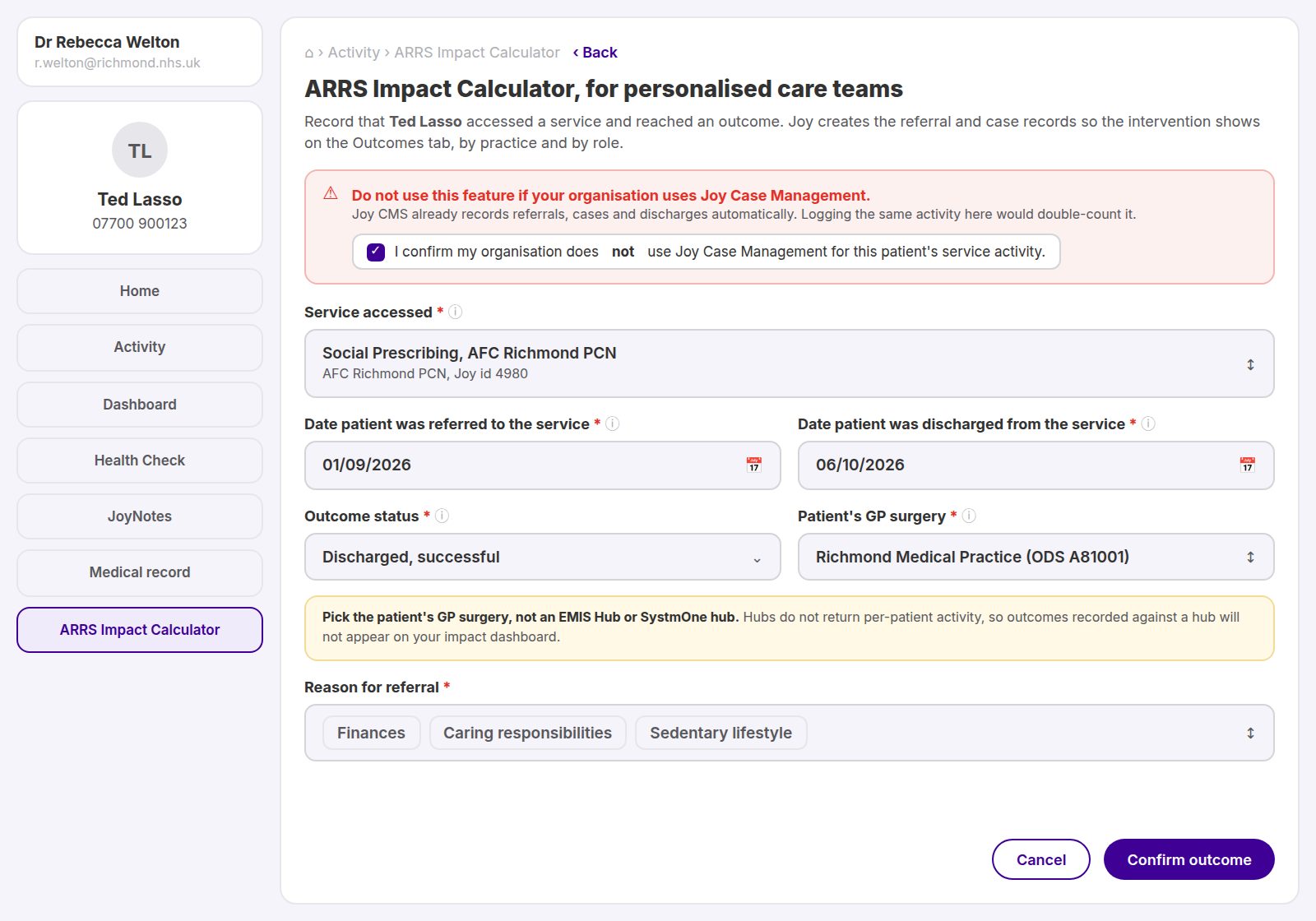
ARRS Impact Calculator
See what your personalised care roles deliver
Link workers, health coaches and care coordinators often work across several practices, which can make it difficult to see what each practice receives from those shared hours.
Joy records each time the personalised care team supports a patient and measures changes in GP contacts and A&E attendances.
Results can be viewed by practice and by role, giving you clearer evidence of what the shared team is delivering for your patient list.
Data protection and clinical safety
Patient identifiers are removed before Joy’s algorithm reviews the record.
The patient’s name, NHS number and date of birth are removed, and the postcode is reduced to its area. The reasoning stage sees only the patient’s age, area and relevant clinical events.
- Never used for training
- Deleted after 30 days
- The practice remains the data controller
- NHS Data Security and Protection Toolkit
- DPIA available for practices and ICBs
- Clinical safety case in place
- ISO 27001 certified
- Registered with the MHRA as a Class I medical device, reference 35016
Every step is recorded, and the final decision always remains with the clinician.
Built for primary care
Joy has worked in the NHS since 2019 and has supported more than 2 million connections to local services.
- Live in around 2,000 practices
- Integrated with SystmOne and EMIS
- More than 100,000 local services
- Over 90% of services are free to patients
- Service capacity is monitored
- Registered with the MHRA as a Class I medical device
- ISO 27001 certified
- NHS Data Security and Protection Toolkit
- Clinical safety case in place
Try the patient experience
See the exact WhatsApp experience a patient receives when their practice refers them through Joy.
The demonstration:
- Greets you by your first name
- Names your practice
- Presents three real services
- Uses the same response buttons patients receive
- Searches near your postcode if you choose “Find me something else”
Patient invitations and replies are sent from GP Surgery by Joy, the messaging service Joy runs on behalf of GP practices.
Take Joy to your partners
Watch the 3-minute explainer
A short overview of who Joy supports, what the clinician sees and what happens after you approve a referral. Forward it to a partner or practice manager.
Download the brochure
The brochure covers:
- Which patients Joy identifies
- Evidence from the GP record
- What the one-click approval looks like
- How Joy follows up with patients
- How it works with or without link workers
- How to activate Joy in SystmOne and EMIS Web
There is no sign-up form.
Straight answers to common questions
- Is this another toolbar?
- It is a small desktop application that sits alongside SystmOne or EMIS. A few times a week, it may ask permission to support a patient.
- Each decision takes about a minute. Clinicians typically spend between 90 seconds and five minutes per week using Joy.
- We already have a risk-stratification tool
- Most risk-stratification tools identify patients and give your team a list.
- Joy identifies the patient, recommends suitable services and handles the contact and follow-up after you approve the referral.
- It was built for primary care, so it looks for patients whose contact with general practice is rising before their needs escalate.
- We do not have a link worker
- You do not need one. Joy can identify the patient, contact them and support them into a local service.
- Our local services are not listed
- For the proactive flow this page describes, it will not matter. About four in five patients Joy supports come from Joy spotting the opportunity and offering it to the practice, matched against a database of around 100,000 services. Where Joy finds a gap in local provision it records it, which starts an internal process reviewed several times a day so the gap is filled quickly. A missing service does not stop Joy working.
- It only matters for the manual flow, where a clinician refers someone themselves, which is about one in five. The public marketplace on this website lists around 20,000 services and the full database is around 100,000. If a new commission or deployment needs specific services added, tell us which and we onboard them as part of the deployment.
- What if the contract is not renewed?
- Practices do not pay for Joy or sign an individual contract. It is normally commissioned across a neighbourhood or ICB.
- If you want Joy to continue, speak to your neighbourhood or ICB lead.
- Does Joy change treatment?
- No. Joy works in addition to clinical care and never changes a treatment plan.
- The information is already in SystmOne or EMIS
- That is correct. Joy uses the existing information to identify the pattern and then handles the patient contact and follow-up that the practice may not have time to provide.
- We have tried something similar before
- Many tools identify work for the practice. Joy is designed to take work away by handling the follow-up after the clinician approves the referral.
- What does Joy read?
- Joy reviews the last two years of the record, including contacts, referrals, missed appointments, coded conditions, frailty markers and the patient’s postcode area.
- It does not review information older than two years.
- Where does the data go?
- Patient identifiers are removed before the reasoning stage.
- The de-identified information is never used for training and is deleted after 30 days. The practice remains the data controller and Joy acts as a processor.
- A DPIA is available for practices and ICBs.
- How is AI involved?
- AI is involved in different parts of the product. When practices ask this question, they usually mean Proactive Care, the part that finds patients and suggests support. Most of that is done without any AI at all.
- It is done by a set of fixed rules running on Joy’s own servers. Those rules look at around 60 things in the record, such as whether someone is seeing the GP more often than they used to, and decide whether a patient might benefit from local support. This is the step that handles the sensitive parts of the record, and it gives the same answer every time for the same record.
- AI comes in after that, in two places. It finds services: with the patient’s name and other identifiers already removed, it searches our list of around 100,000 local services, much as you might type “get fit, make friends in RM1”, and picks out the ones that fit. And it does a safety check, looking for anything that suggests a safeguarding issue or a purely medical problem, so those patients are left alone.
- The AI never sees a name, NHS number, date of birth or full postcode. Nothing is used to train it. And it never makes the decision. You do.
- Elsewhere, Joy uses AI in places that have nothing to do with patient records. Our search forgives typos and knows everyday names, so “CAB” finds Citizens Advice and “Singing for the Brian” finds Singing for the Brain. And an AI tool checks that services are still running, and takes down the ones that are not.
- Will Joy ask about every patient?
- No.
- In a typical practice, Joy asks for a decision between one and five times per week. Patients who do not clearly meet the criteria are held back, and patients whose needs are purely medical or already well supported do not appear.
- Joy never asks about the same patient twice.
- Can I refer someone myself?
- Yes. You can refer any suitable patient from inside SystmOne or EMIS. Choose the service and Joy handles the follow-up.
- Who is responsible for the referral?
- The clinician is responsible, as with any referral.
- Joy makes a suggestion, but a clinician decides. Joy never contacts a patient or changes a care plan without approval.
- Is Joy a medical device?
- Yes. Joy is registered with the MHRA as a Class I medical device, reference 35016. It also has a clinical safety case and is ISO 27001 certified.
Trusted by ICBs, PCNs and practices across England














Bring Joy to your area
Joy is commissioned for whole neighbourhoods and ICBs, so every practice in the area can use it.
Your practice does not pay or sign an individual contract.
If you would like Joy in your area, tell us. We will speak with your neighbourhood or ICB lead.
Joy is the referral infrastructure that shifts demand into the community.